Vertical Slice
During the Monday lecture of the first week, I was introduced to the concept of a vertical slice in game development. Before this, I had mostly thought about game development in terms of isolated components such as mechanics, art, or narrative. The idea of a vertical slice helped me understand how these individual elements are meant to be connected and experienced together.
A vertical slice is essentially a small but complete and playable portion of the game. It takes the core ideas described in the GDD, including gameplay mechanics, visual direction, and intended player experience and brings them together into a functional build. Rather than focusing on the quantity of content, the goal is to demonstrate the essence of the game in a playable form. This lecture helped clarify what we should be aiming for throughout the semester and how our design decisions should always support playability and coherence.
Project Overview
During the Thursday session that week, we were informed of our team allocations. I was assigned to Elina’s project, Soul Keeper, where I served as Mechanic Designer. The project is centred around themes of compassion, trust, and responsibility towards wildlife, and places the player in the role of a forest keeper who interacts with animals and their environment.
Based on Elina’s GDD, we worked together as a group to organise and clarify the game loop. This process involved breaking down the intended player actions—exploration, resource collection, animal interaction, puzzle solving, and understanding how these systems feed back into each other. Elina’s game pillars became an important guiding framework for us, ensuring that all mechanics and features aligned with the emotional and experiential goals of the game.
Defining the Game Loop
From the GDD and our discussions, we established a clear core loop:
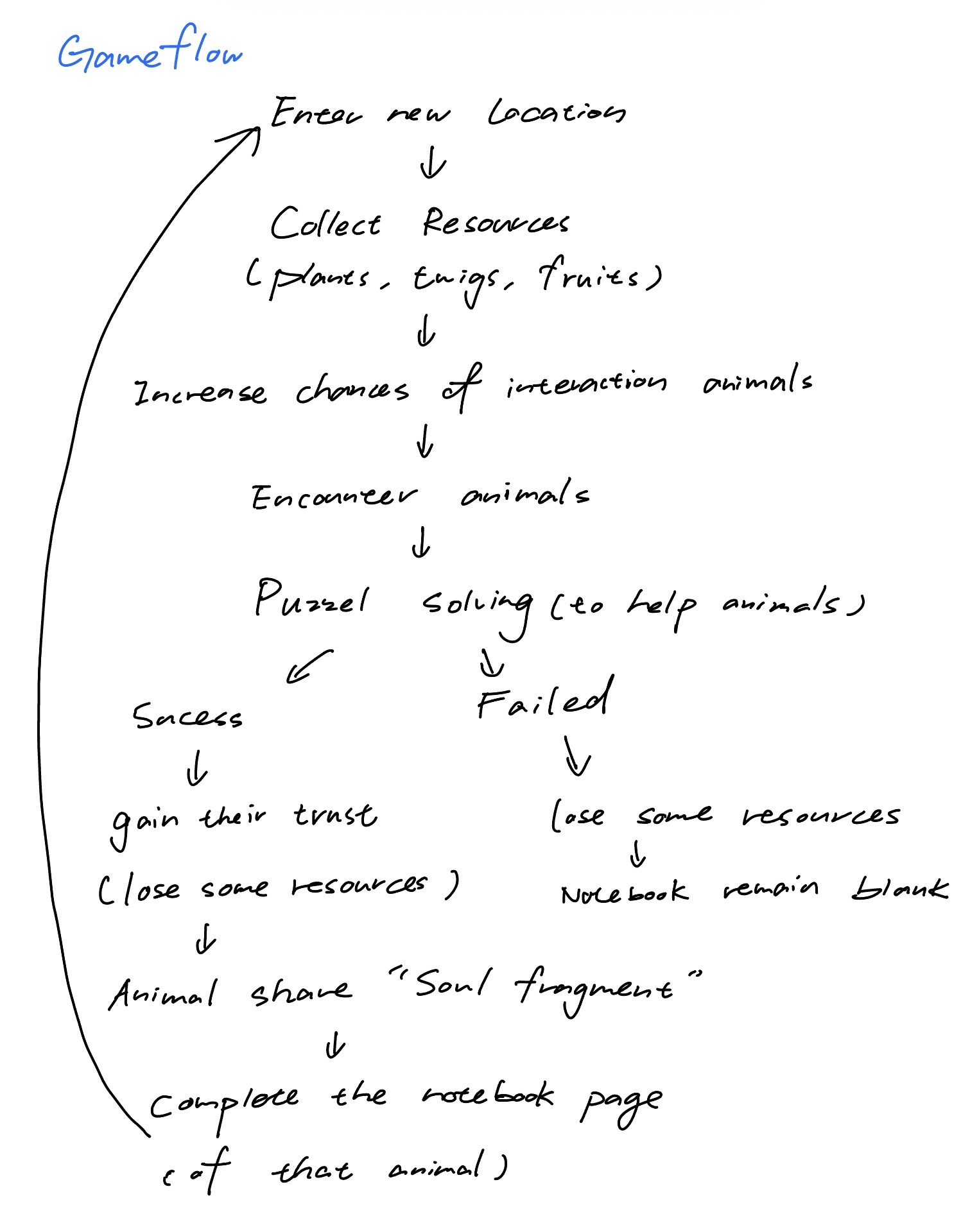
This loop reinforces the game’s themes by encouraging patience, observation, and thoughtful decision-making rather than rushing or optimising purely for efficiency.
Team Structure and Workflow
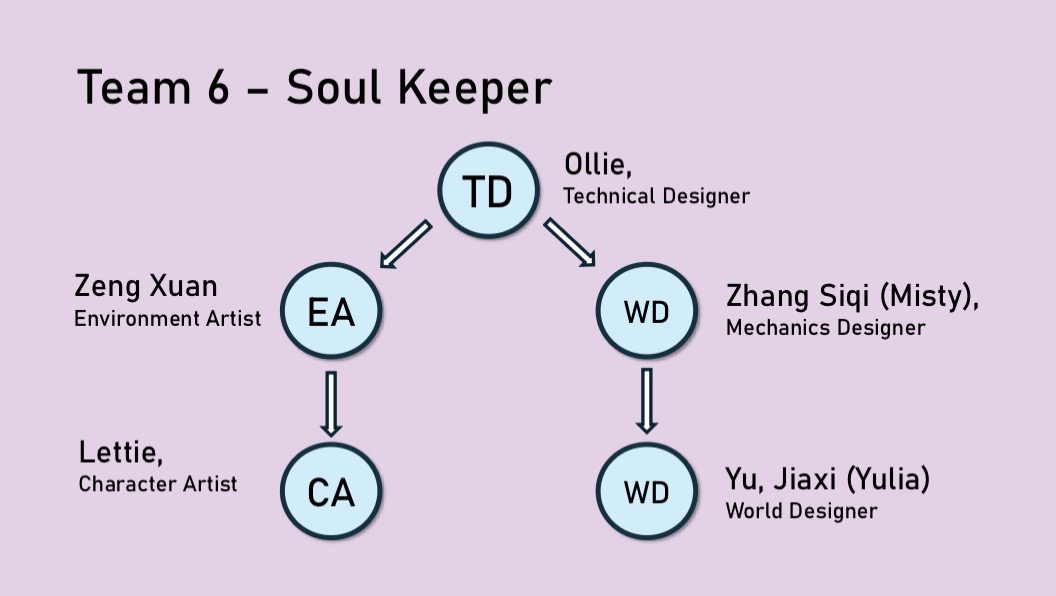
To ensure efficient collaboration, I suggested dividing the team into two main sub-groups:
Art Team
Lettie: Character art
Swan: Environment art
The art team focuses on establishing a consistent visual style by gathering references, creating mood boards, and aligning on colour palettes, textures, and artistic mediums. This shared visual language is important to maintain cohesion across all assets.
Tech Team
Ollie: Technical Designer
Myself: Mechanic Designer
The tech team is responsible for implementing gameplay systems in Unity. Our immediate priority is to create a stripped-down, playable prototype using greyboxing. This allows us to test movement, interaction, and core mechanics without being blocked by unfinished art assets.
To support collaboration within the tech team, I set up a GitHub repository for the Unity project. This allows us to work on the same project simultaneously, manage version control, and avoid conflicts as the project grows in complexity.
Reflection
This first week helped me better understand not only what a vertical slice is, but also how important team structure and early planning are in game development. Translating abstract ideas from a GDD into a playable experience requires constant communication between design, art, and technology. Setting up clear roles, workflows, and tools early on has given our team a strong foundation to build upon as we move into prototyping and iterative development.
GameJam
This weekend I joined and made my first game in the Global Game Jam, and it was so much fun. The very limit of time (48 hours) really pushed me forward, and I learned a lot.
Click here to view and play: GlobalGameJam2026.
Leave a Reply