* Note: This is a summary of my initial version of GDD. The final version changes and adds a lot of ideas that are different from the initial version. Ideas Just showing the process of changing my game ideas.
Game Design Document (GDD) Template
- Game Overview
Title:
Celebration Town
Elevator Pitch:
This is a warm and charming cooking party game where players complete mini-games to cook, decorate, and celebrate all manner of occasions. It’s a story about companionship, creation, and celebrating life.
Genre:
Cozy life simulation/Cooking/ Mini Game/Social crafting
Platform:
PC
Target Audience:
Age: 12 +
Suitable for those who like party games and light-hearted creative games. Such as 《Animals Crossing》, 《 Stardew Valley》,《Party Animals》and 《Overcooked》.
Suitable for players who enjoy teamwork, cooking, building, and management game experiences.
Suitable for players who enjoy a warm, charming, and relaxed gaming style.
Suitable for those who enjoy small animals, as the majority of character choices in the game are small animals.
Design Intention:
Allow players to experience the warmth and joy of community collaboration and festive traditions.
May players overcome the barriers of distance, maintaining connections with friends through daily interactions and collaboration within the game.
We hope players will experience the joy and rich festive atmosphere of different holidays.
We encourage players to learn the little stories behind each celebration.
Essential Experience:
I hope players can leave all their real-life troubles behind in the game, savour the festive cheer it brings, and feel the warmth, sense of belonging, and joy of creation alongside friends within the communities they build.
Game Design Pillars:
1. Cooking and Creativity:
Players may assume the roles of various animals within the game. Participants are divided into distinct teams (formed at the players’ discretion), with one group venturing to different areas to gather ingredients (through mini-games). At the same time, another remains in the kitchen to prepare dishes according to seasonal festivities. The difficulty of collecting ingredients varies, as does the complexity of crafting each dish.
2. Community and Collaboration:
A community may accommodate up to ten players, each possessing their own house within the settlement, which they may furnish at will. During major holidays, a communal gathering place shall be opened for players across all platforms to celebrate together. Each community features a notice board where residents may share information (exchanging or trading materials and ingredients, posting distress calls, or engaging in conversation).
3. Customization and Decoration:
Before entering the game, players may customise their character’s appearance. Within the game, players can determine their house’s location within the community and decorate their property.
4. Festivals and Seasons:
The game drives the world’s rhythm through a festival cycle, with each festival bringing new themes, quests…
Core Values/Keyword/Tone:
Warth
Togetherness
Celebration
Creativity
Harmony
- Player Experience:
Player Motivation:
Players are motivated by the sense of belonging that comes from collaborating with friends and celebrating festive occasions. This game fosters feelings of warmth, joy, pride, and connection, as every small contribution impacts the entire celebration.
Player Agency:
Players can customise their character’s appearance.
Players can decorate their houses themselves and customise their house locations.
Players may freely choose their community.
Players may freely choose how to participate in festival preparations (cooking, gathering ingredients, decorating the community).
This will affect the relationships between characters, the theme of the festival, and the outcome of the celebrations.
Player Journey:
Onboarding:
Players move into the community, select their preferred location, and construct their new home. They learn fundamental cooking techniques and decorating skills, interacting with fellow residents within the community.
Mid-game:
Players formally commence preparations for the festive celebrations, collaborating with fellow community members to prepare the holiday feast and decorate the neighbourhood, unlocking additional recipes, ingredients, and props.
Endgame:
The festive celebrations commence, with players showcasing community achievements, sharing refreshments, and receiving commemorative gifts.
Each festive celebration marks a new chapter in the community’s story.
- Core Gameplay:
Core Loop:
Collect food – Cook – Decorate – Celebrate- Reset
Mechanics:
Cooking mini game (timing, cooperation, combo system)
Resource collecting (fishing, planting, trading)
Decoration placement and customization
Relationship system
Festival event management
System:
Progression: Cooking Section: Following each festival, new recipes and ingredients become available for use in subsequent rounds. The community will develop additional spaces to accommodate the new ingredients. Players will upgrade their culinary skills.
Economy: Rewards upon task completion. Transactions between communities.
Narrative: the community evolves visually and emotionally through each festival.
Scoring: Festival “success” determined by cooperation, creativity, and harmony – not competition.
Constraints:
The preparation period for each festival is limited, requiring players to complete all festival preparations within the allotted time.
- Narrative and World
Story Premise:
Worldbuilding:
Characters and Roles:
Example Scenarios:
- Art Style
Moodboard:
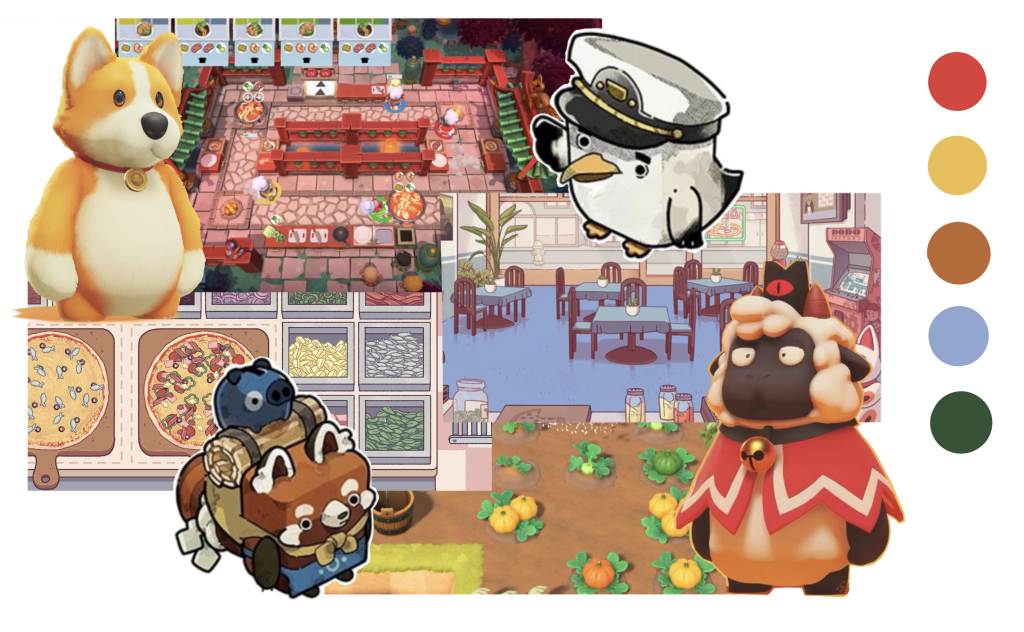
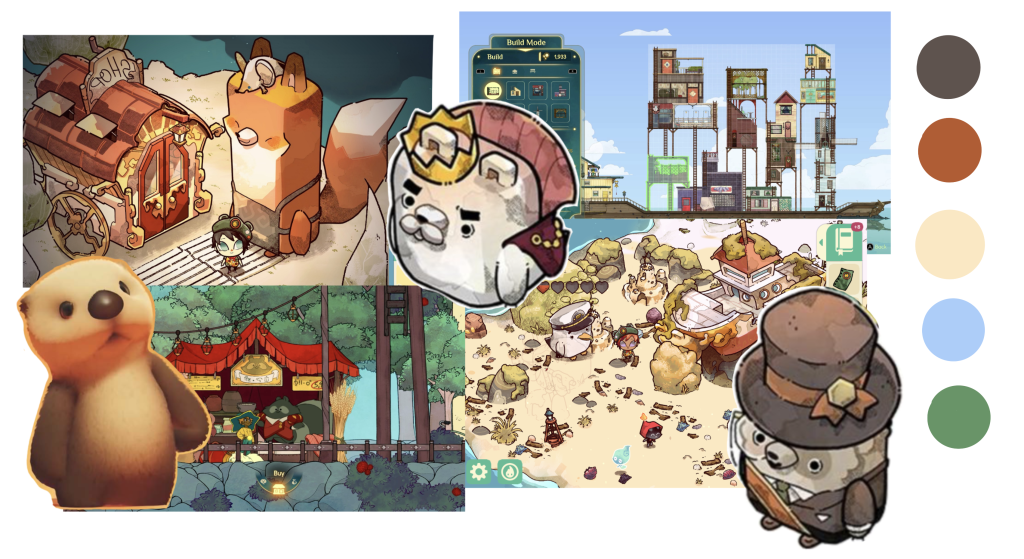
Style Guide:
Color Palette: The game features a vibrant colour palette with rich hues. It predominantly employs warm shades such as orange-yellow, sky blue, and grass green, complemented by fresher, more delicate tones.
Typography: Use a rounded, cute-style font
Motifs:
Characters/Environment sketches:
Animation:
- Sound Design and Music Direction
- Structure and Progression
Level/Stage Overview:
The game replaces traditional levels with “festival cycles”.
- Preparation period (Collect)
- Cooking period (cook)
- Decoration period (Decorate)
- Celebration period (Celebrate)
As the calendar progresses, the community will welcome new festive themes.
Difficulty Curve:
Early stage:
The beginner tutorial and exploration phase, where tasks are straightforward and primarily serve as an introduction to the community.
Middle stage:
As various minor holidays arrive, players must collaborate to complete tasks while managing their time effectively, though the tasks themselves are straightforward.
Late stage:
As major festivals approach, gathering ingredients and cooking become more intricate, with larger areas requiring decoration and an overall increase in difficulty. This demands greater coordination and time management among players.
Onboarding and Tutorialisation:
Players may select either Beginner Mode or Veteran Mode. In Beginner Mode, players must first enter a dedicated community where NPCs are present; players may interact with these NPCs to learn the game’s fundamental mechanics. In Veteran Mode, players may proceed directly to their chosen community.
- Technical and Production Notes
- Market and Player Community
- Testing and Evaluation
Leave a Reply