Note:
Narrative Designer:
- Bigger picture narrative decisions
- May be more senior (not always)
- Overlap with game designers
- Works a lot with other departments
- Might be developing characters, mechanics, setting, lore, overarching plots
Narrative is important:
- Provides stakes and context to mechanics
- Engages players
- Sometimes it’s the main point
Writing Tips:
Maximising Impact for Choices
- emotional impact of the choice
- Introduce choices and consequences early
- Not all choices have to change the plot
Limiting Scope
- Draw out your branches
- the impact of splits
- Look for opportunities to merge branches
- Reuse what you can
Dialogue Tips:
- Make sure you know limits
- Review the pacing in the format of the game
- Awkward dialogue is hard
Class Activities:
1.
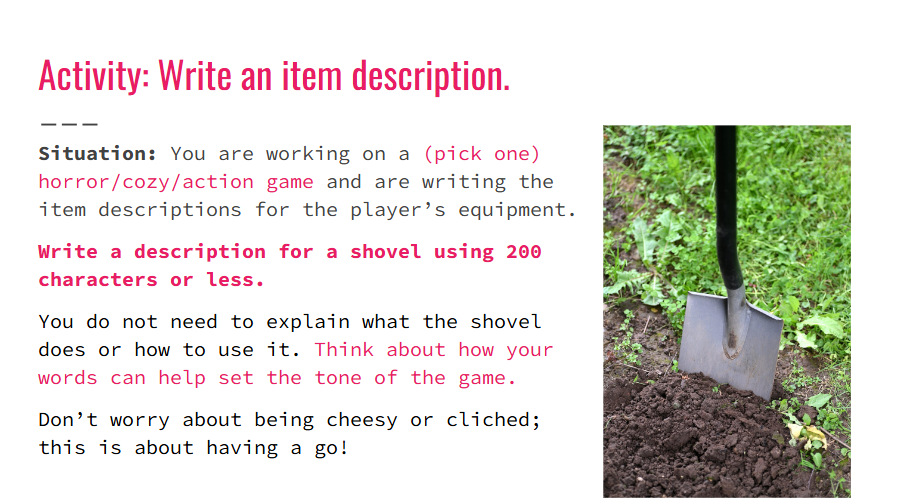
First, I’ve chosen this as a cosy family game.
My description of the spade:
This is a small pink plastic children’s trowel. It is covered in stickers featuring cartoon animals and animated characters. The trowel is stuck in the soil of a household’s back garden, with damp earth and scattered petals from flowers still clinging to it.
Word count: 43
2.
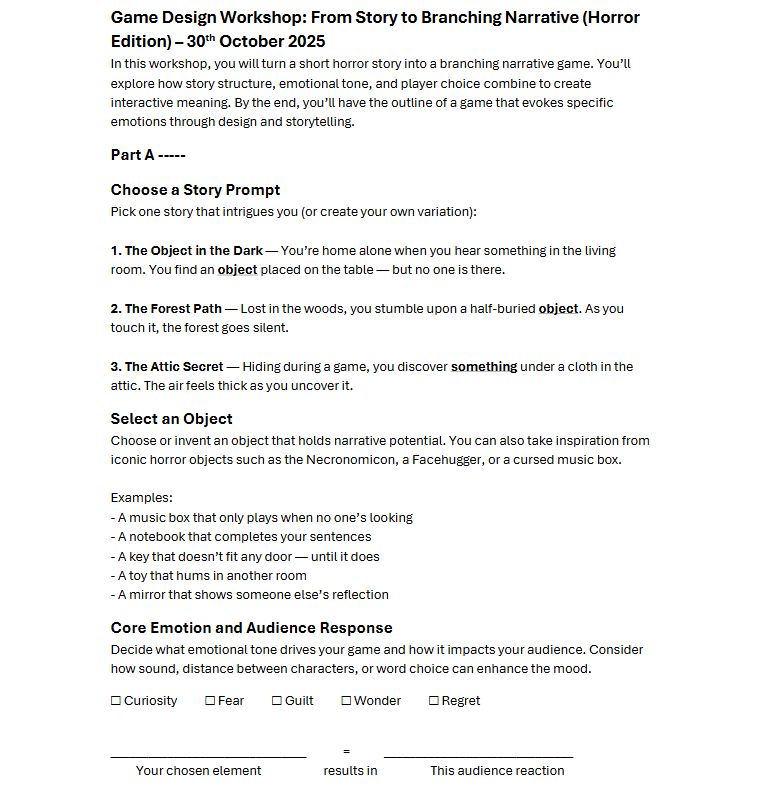
My choise of part A:
Choose a Story Prompt:
2. The Forest Path — Lost in the woods, you stumble upon a half-buried object. As you touch it, the forest goes silent.
Select an Object:
– A mirror that shows someone else’s reflection
Core Emotion and Audience Response:
A mirror that shows someone else’s reflection = Curiosity
Your chosen element = This audience reaction
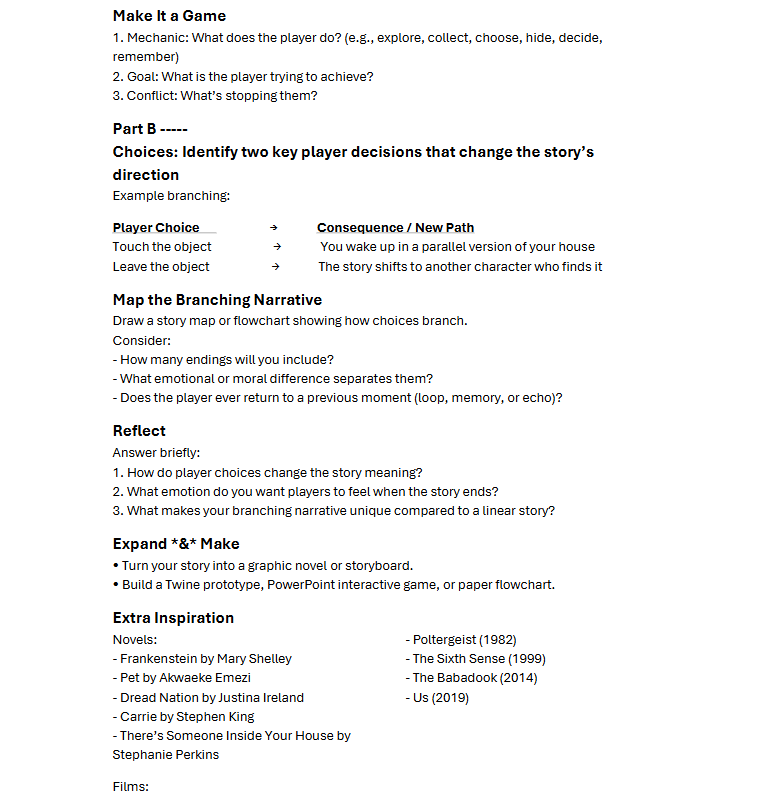
Make It a Game:
- Mechanic: collect, decide, explore.
- Goal: Players must endeavour to break free from the mirror’s curse.
- Conflict: Escaped the mirror/death
As this is a group activity, this is my choice for Part A. My group partner is Iris, and following our discussion and selection process, we have opted for Iris’s choice.
The plot of Iris revolves around a music box in an attic that plays by itself. Whenever the player approaches the music box, the music ceases; whenever they move away from it, the music resumes playing on its own.
Part B:
Choices: Identify two key player decisions that change the story’s direction
- The player finds this music box rather peculiar and wishes to avoid any trouble. Deciding it’s better to mind one’s own business, they choose to discard the music box/give it away to someone else/destroy it. Ultimately, the music box vanishes, leaving the player behind. The player resumes their ordinary life, with no further connection to the music box or the story behind it (game over).
- The player found this music box rather peculiar, unlike any other they had encountered, sparking their curiosity. They resolved to uncover the reason behind it. Through repeated attempts, the player sought to coax more sounds from the music box, hoping to gather further clues. The music box senses the player’s thirst for knowledge and offers hints, guiding them step by step towards uncovering the truth. The player uncovers all truths (Game Over) / The player dies due to the dangers encountered while seeking the truth (Game Over).
Map the Branching Narrative:
- There are three fundamental outcomes in total(The player returns to normal life, The player uncovers the truth, The player dies).
- Players will experience two emotions: fear and curiosity. Because the music box is so peculiar, some players will be afraid, while others will be curious.
- Upon death, players may return to the previous scene to revive. Players require the memories from each scene; only by piecing together all these recollections can the truth be uncovered.
Leave a Reply