Mondy Guest Talk:
Through this lecture, I learned:
- Real-world production experiences of indie game teams
- How small teams can increase success rates through production mindset
- How to avoid scope creep
- How to create high-quality work within limited timeframes
12 Key Recommendations for Game Development:
1.Games are constantly iterated.
(From prototype → testing → modification → retesting)
2.Conduct as many playtests as possible.
If there are parts of the game that require explanation, it indicates that the design of those sections is flawed and needs to be revised.
3.Game development is a long-term endeavor.
Communication with the team is paramount. Make sure to communicate frequently with your teammates and keep everyone on the same page.
4.Make sure the goals
5.Work Backwards
Break down from the end goal. Risks can be detected in advance
6.Track progress
7.Beware of bottlenecks and dependencies
Example:Art assets not delivered → 3D work impossible → Scenes cannot be created. The team needs to communicate more, plan ahead, and flexibly adjust the game plan. When time is insufficient, content must be cut.
8.Lay a solid foundation
Gameplay Pillars is solid foundation
9.Less but Higher Quality
If there too much content – Ask yourself if you truly need all these features. Is user experience more important, or content density?
Don’t be afraid to cut features—eliminate anything unrelated to the core content.
10.Don’t leave the tough stuff for last.
11.Don’t forget players
player exoerence is the most important
12.The game requires extensive explanation.
If players don’t understand your game or its logic, you can use UI prompts, environmental cues, level design, and clear objectives to guide them.
Tursday:
Precentation:
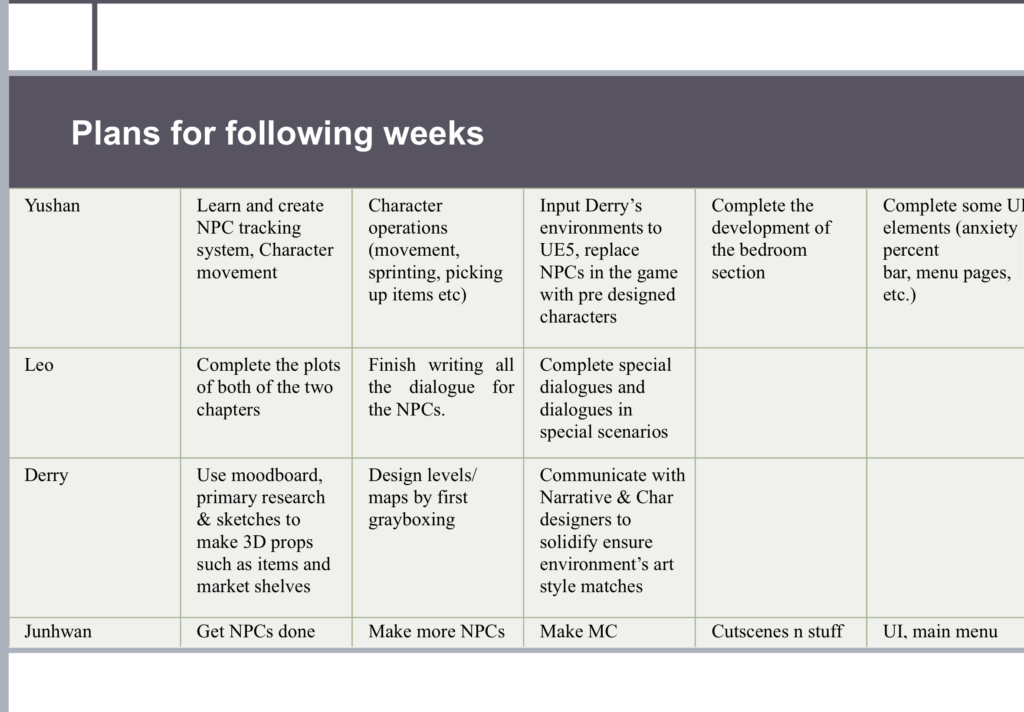
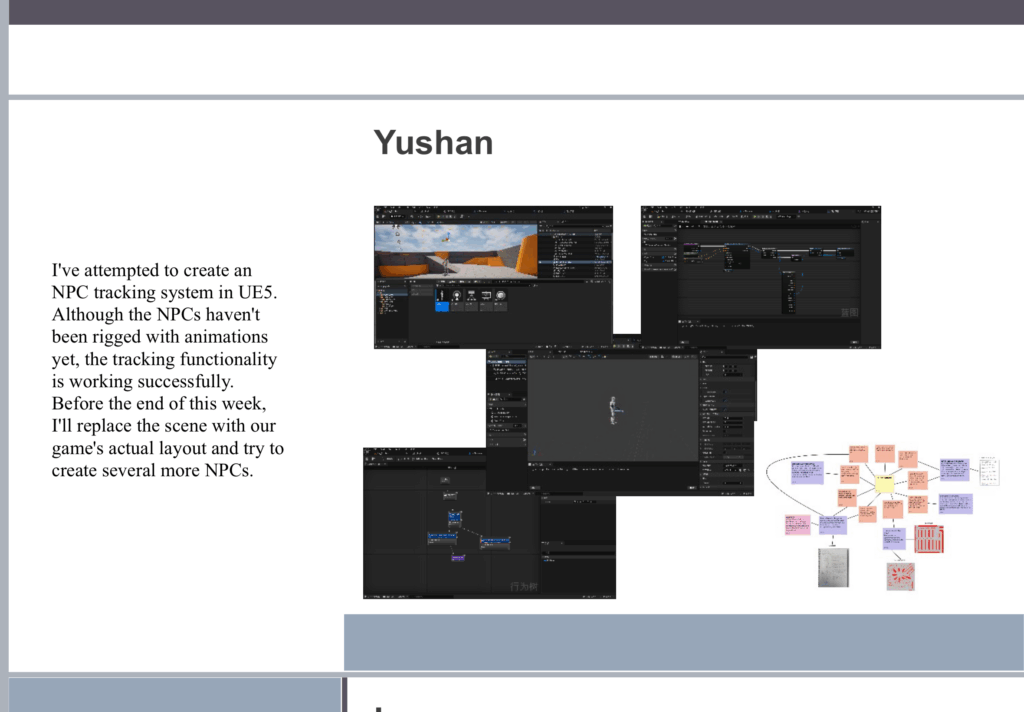
These two slides outline my plans for the coming weeks and what I have accomplished this week.
As the fifth week is dedicated to playtesting, my plan is to complete the most fundamental mechanics (player movement, item picking up, NPC patrols and player tracking) before the fifth week. Since the environment has not yet been modelled, I shall use cuboids as placeholders to ensure a playable state.
I’ve been torn between Unity and UE5, as I spent the entire previous academic year developing games solely in Unity. This marks my first encounter with UE5, and I’m concerned that adapting to new software might prove rather time-consuming. This morning, Ross and I discussed which engine to use for game development. UE5 supports Blueprints, which is somewhat more accommodating for someone like me with limited programming foundations. However, I’d forfeit some of the tutors’ assistance, as Ross is far more proficient in Unity.
This week I experimented with creating an NPC tracking system using UE5, and I found it relatively straightforward to get to grips with. Consequently, I shall endeavour to implement further mechanics this week to swiftly adapt to the new engine.
NPC tracking system:
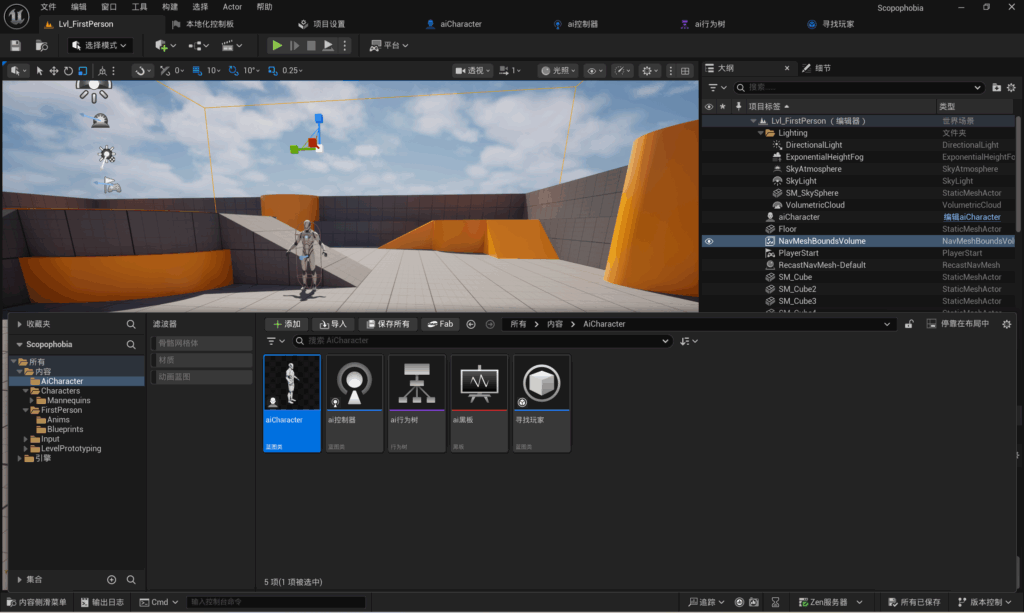
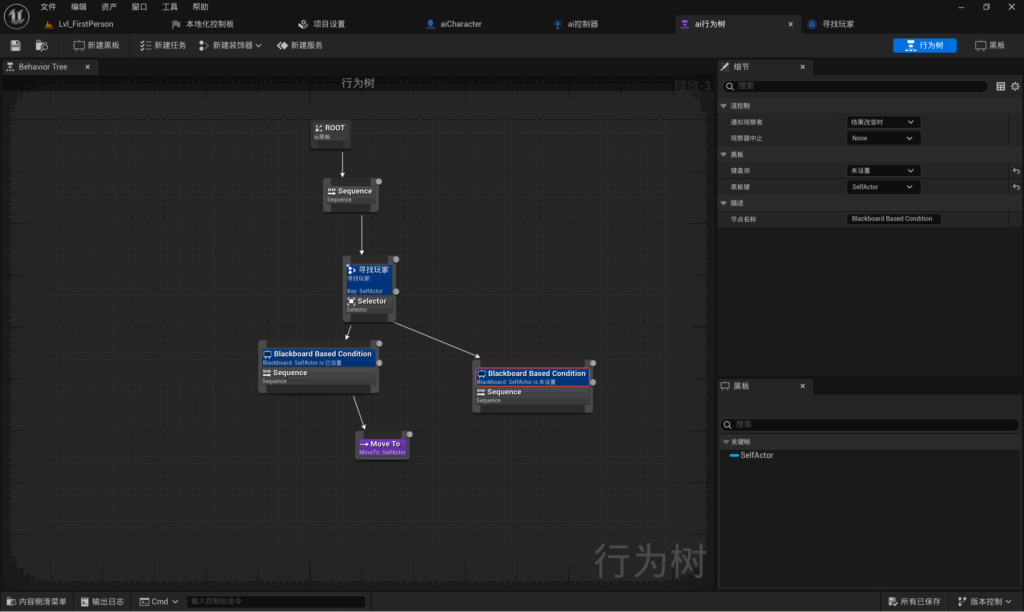
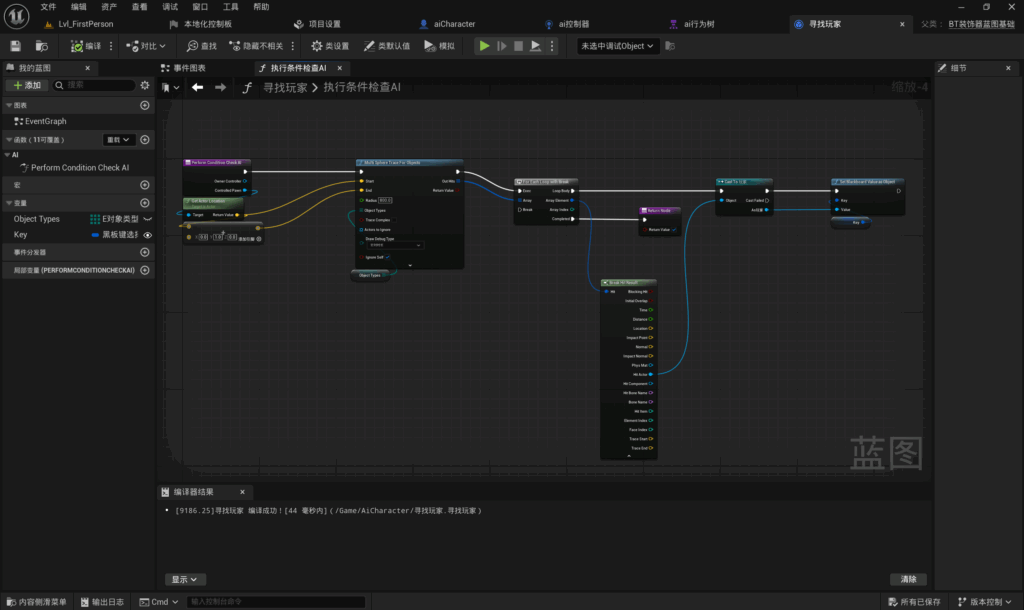
The NPC tracking system enables NPCs to pursue players when they approach, ceasing pursuit once the player moves beyond the NPC’s active range. However, this particular NPC’s speed is excessively rapid, and I am currently attempting to reduce its movement velocity.
Subsequently, I shall implement a patrol system for NPCs, enabling them to move within designated areas with greater flexibility.
Mechanic List:
I first outlined the game’s general flow in black, highlighting the corresponding mechanics for each step in red.
I have revisited the core mechanics outlined in Scopophobia’s Game Design Document. This flowchart summarises all the mechanics, enabling me to gain a clearer understanding of the systems I need to complete.
Group Communication report:
I have written this week’s group discussion report, here is the link to our group’s report for this week.
Group working progress:
I have summarised our team’s progress this week, here is a link to the individual progress reports for each member of our team.
Leave a Reply